
The AI Selloff: A Sharp Rebound Tests the Market’s Conviction in the Technology Trade
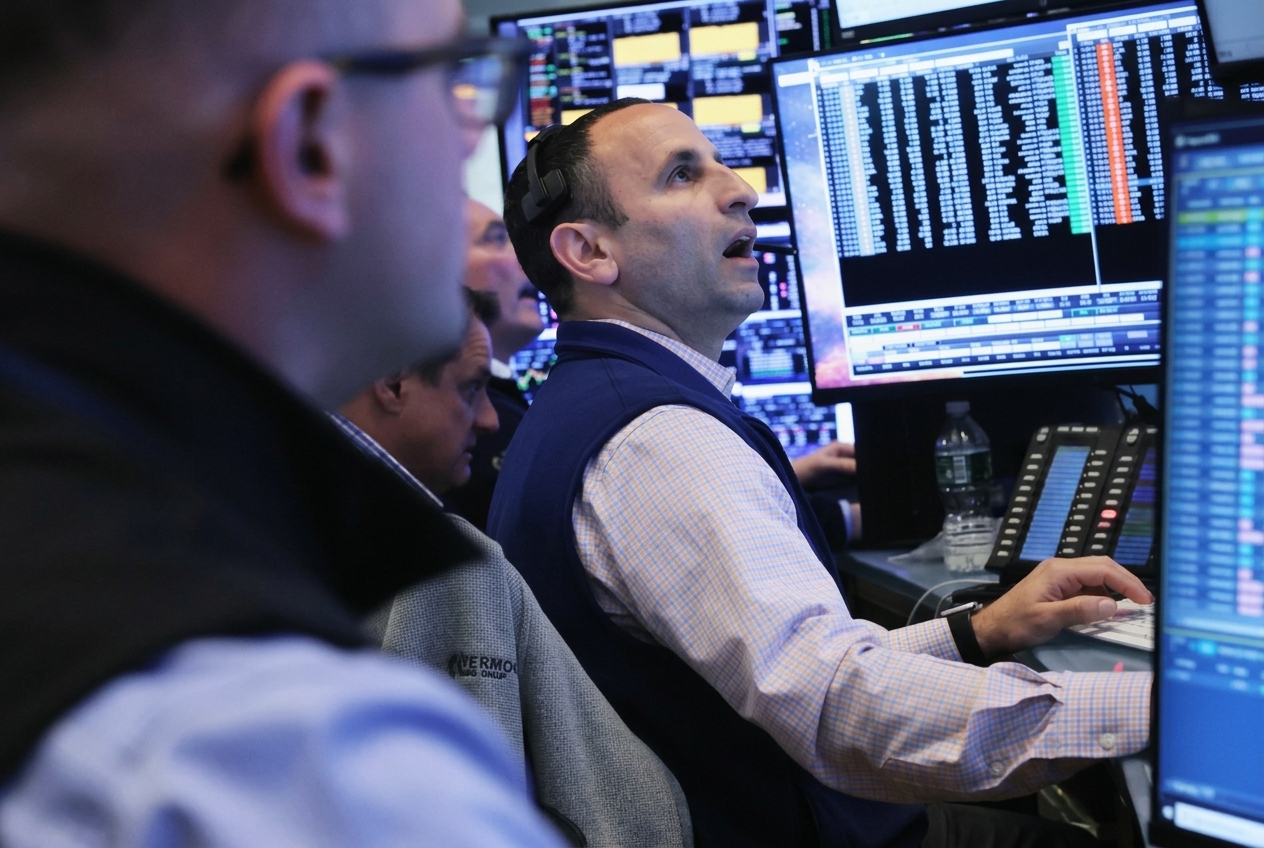
U.S. equity futures advanced sharply Monday as investors returned to technology and artificial intelligence-related shares following a severe selloff that exposed growing concerns about the economics of the AI investment cycle.
The preceding week’s losses pushed the S&P 500 and Dow Jones Industrial Average more than 10% below their respective record highs, confirming corrections in both benchmarks. The Nasdaq Composite declined more than 10% during the week, turning negative for the year.
The magnitude of the adjustment was particularly pronounced among semiconductor companies and businesses associated with AI infrastructure.
At 7:01 a.m. Eastern Time on Monday, Nasdaq-100 futures had advanced 3.43%, S&P 500 futures were up 2.77%, and Dow futures had gained 2.01%.
NVIDIA shares rose approximately 8% in pre-market trading, while Advanced Micro Devices, Broadcom and Micron Technology also recorded substantial gains.
These observations indicate a significant recovery in investor positioning following the previous week’s losses. They do not establish that the underlying concerns have been resolved.
The central issue is whether the recent decline represents a temporary correction in an otherwise durable investment cycle or the beginning of a more fundamental reassessment of the returns expected from artificial intelligence infrastructure.
The Selloff Exposed a Valuation Problem
The recent decline was not simply a reaction to elevated technology valuations.
It reflected growing scrutiny of the relationship between the capital committed to artificial intelligence infrastructure and the economic returns that investment is expected to generate.
The expansion of AI computing capacity requires substantial expenditure across semiconductors, data centers, networking equipment, electricity infrastructure and specialized cooling systems.
These investments support a potentially transformative technological development. However, the scale of the opportunity does not automatically establish the profitability of the companies participating in it.
Investors must distinguish between demand for computing capacity and the economic value ultimately captured by infrastructure providers.
Strong demand can support revenue growth while simultaneously creating pressure on margins, financing requirements and returns on invested capital.
For companies undertaking substantial capital expenditure, the relevant question is not simply whether demand continues to expand.
It is whether the incremental earnings and cash flows generated by that expenditure justify the capital committed.
That distinction has become increasingly important as the market reassesses the valuations assigned to companies whose growth expectations are closely linked to the expansion of AI infrastructure.
Capital Intensity Is Becoming a Central Investment Variable
The economics of AI infrastructure introduce a particular challenge for investors.
Unlike business models that can expand primarily through software distribution or relatively limited incremental investment, large-scale computing infrastructure requires substantial physical capacity.
Data centers require land, buildings, electrical connections, power availability, cooling systems and specialized computing equipment.
These requirements create significant upfront capital commitments before the resulting capacity can generate commercial returns.
The economic outcome depends on several factors, including utilization rates, customer demand, pricing power, operating expenses, equipment depreciation and financing costs.
A company can successfully expand its infrastructure footprint while generating returns below those anticipated by investors.
This possibility becomes especially relevant when market valuations already incorporate substantial expectations for future growth.
If capital expenditure continues to increase but the monetization of AI services develops more slowly than expected, the resulting pressure may affect both earnings expectations and valuation multiples.
Conversely, businesses capable of converting infrastructure investment into durable operating cash flow may prove more resilient than companies whose financial performance depends primarily on continued expansion.
The recent selloff indicates that investors are becoming more selective about this distinction.
The market is increasingly evaluating the quality of growth rather than simply its projected scale.
Why the Rebound Is Not Yet Confirmation of Recovery
Monday’s advance is significant because it follows a substantial reduction in technology exposure.
However, the magnitude of a rebound must be evaluated in relation to the conditions that preceded it.
When highly concentrated positions experience rapid liquidation, subsequent price movements can be amplified by short covering, portfolio rebalancing and opportunistic purchases.
These dynamics can generate substantial gains without requiring a corresponding improvement in corporate fundamentals.
This is particularly relevant for capitalization-weighted indexes.
The largest technology companies represent a considerable proportion of major U.S. equity benchmarks. Consequently, a strong recovery among a relatively small group of constituents can materially improve index performance.
That does not necessarily indicate a broader improvement in market participation.
A more durable stabilization would require evidence that buying interest is extending beyond the most heavily traded AI and semiconductor companies.
The performance of smaller companies, equal-weighted benchmarks and sectors with different earnings drivers will therefore be important in evaluating the quality of the recovery.
The distinction is not between a positive and negative trading session.
It is between a market that is recovering because investors are rebuilding exposure after an aggressive selloff and one in which the underlying assumptions supporting valuations are becoming more credible.
Monday’s pre-market advance establishes the former possibility. It does not yet establish the latter.
Financial Conditions Reinforce the Repricing
The technology selloff has also highlighted the sensitivity of growth-oriented equities to financing conditions.
Companies involved in AI infrastructure frequently operate within capital-intensive business models, making the cost and availability of financing important determinants of project economics.
Higher interest rates can increase borrowing expenses, raise the required return on new investments and reduce the present value of future cash flows.
These effects are particularly relevant for businesses whose valuations depend on earnings expected several years into the future.
However, the relationship between interest rates and technology valuations should not be interpreted mechanically.
The implications of higher yields depend on their underlying drivers, including inflation expectations, nominal economic growth and monetary policy.
For infrastructure businesses, the more important question is whether prospective project returns remain attractive after accounting for financing costs and operating requirements.
A lower cost of capital can improve project economics, but it cannot compensate indefinitely for insufficient utilization, weak pricing power or inadequate customer demand.
The current market adjustment therefore places greater emphasis on the relationship between financing conditions and the actual economics of AI infrastructure investment.
The Implications for Semiconductor and Infrastructure Companies
The concentration of recent losses in semiconductor shares reflects their central position within the AI investment cycle.
Companies supplying advanced processors, memory, networking components and related equipment are exposed to substantial demand from data-center operators and technology platforms.
Their financial performance, however, depends on more than aggregate industry expenditure.
Production capacity, technological differentiation, pricing, customer concentration and capital requirements influence the amount of economic value each company can capture.
The same distinction applies to businesses involved in data-center construction, power delivery and cooling infrastructure.
These companies may benefit from continued expansion in computing capacity, but their returns depend on contract economics, execution costs, utilization and the financial strength of their customers.
The market is therefore moving toward a more differentiated assessment of AI exposure.
Participation in the infrastructure expansion is not, by itself, sufficient to establish an attractive financial position.
The quality of the underlying business model and its capacity to generate sustainable cash flow remain decisive.
What the Market Needs to Demonstrate
The sustainability of Monday’s recovery will depend on whether the market can establish a more credible balance between growth expectations and financial risk.
Three observations will be particularly important.
First, the breadth of the rebound should improve. A recovery concentrated in a limited number of large technology companies would provide less evidence of broad stabilization than an advance supported by wider market participation.
Second, investors will need greater confidence in the economic returns associated with AI infrastructure spending. Revenue growth and capital expenditure should be evaluated together with operating margins, cash generation and returns on invested capital.
Third, the market must demonstrate that current valuations can withstand changes in financing costs and growth expectations without triggering another significant reduction in risk exposure.
These conditions are interconnected.
A business with strong demand but insufficient cash generation may remain vulnerable to higher financing costs. A company with attractive operating economics may nevertheless experience valuation compression if investors require a higher return for holding its shares.
The distinction between operating performance and market valuation is therefore essential when assessing the current correction.
The Bigger Picture
The recent technology selloff represents a reassessment of the financial assumptions underlying one of the market’s most important growth themes.
Artificial intelligence remains a significant technological development, but the expansion of its infrastructure does not guarantee that every participant will generate attractive returns.
The distinction between technological adoption, capital expenditure and economic value creation is becoming increasingly important.
For investors, the challenge is to identify which businesses can translate expanding demand into sustainable earnings and cash flows, rather than relying exclusively on the projected scale of the AI market.
Monday’s rebound demonstrates that investors remain willing to re-engage with technology exposure following a substantial repricing.
Whether that willingness develops into a durable recovery will depend on evidence that the capital committed to AI infrastructure can generate returns consistent with the expectations embedded in market valuations.
The central question is no longer simply how large the AI opportunity can become.
It is how much sustainable economic value the companies participating in that opportunity can ultimately capture.
That distinction will remain fundamental to the direction of technology valuations and the broader U.S. equity market.
Important Information
This material was prepared by Wavelength Financial Content, an independent third-party content provider, and is published with the authorization of Quassar Capital, L.P. ("Quassar Capital"). Opinions expressed are as of the date of publication and are subject to change without notice. They do not necessarily reflect the views of Quassar Capital or its affiliates.
This material is provided for informational purposes only. It is not investment, legal, or tax advice, a recommendation to take any action or make any investment decision, or an offer to sell or a solicitation of an offer to purchase any security, financial product, or interest in an investment vehicle. Forward-looking statements, forecasts, and estimates are illustrative, subject to risks and uncertainties, and may not be realized. Past performance is not indicative of future results.
Information has been obtained from sources believed to be reliable but has not been independently verified, and no representation or warranty is made as to its accuracy or completeness. References to third-party companies, products, or trademarks are for identification only and do not imply sponsorship, affiliation, or endorsement. See the Disclosures and Terms of Use pages on this website for additional information.
© 2026 Quassar Capital, L.P. All rights reserved. Reproduction or distribution of this material, in whole or in part, is prohibited without the prior written consent of Quassar Capital.